I’ll not quickly forget the night that the bombs stopped in April 2026.
Jan and I had been in the Middle East for about two weeks. Within moments of our arrival, we heard the air raid sirens for the first time. Then a few minutes later came the explosions, the interceptors finding the incoming rockets and drones somewhere overhead. It happened every day, several times a day, until it stopped feeling like an emergency and started feeling like the weather.
In the daytime, people simply went on. Kids played soccer in the street. Old women pushed little rolling carts to and from the grocery store. Men unloaded trucks into the small shops along the main road. A war was happening above us, and beneath it, ordinary life.
The night the bombs stopped did not start out quietly.
It started with a phone call. A family member, frightened for us, had heard from a friend of a friend who worked for the government. The sense was that things were about to get worse, and quickly. Her message was clear: “Get out! Get out now!” That was also the night the threats escalated, when the rhetoric from world leaders turned from posturing into something that sounded like a countdown. We messaged our local friends. They told us to stay away from one part of the city that had appeared on a list of likely targets. We texted a friend back home who had contacts in an “alphabet agency” that could get us to a safe place, and asked the question that was filling our thoughts: “Should we be worried?” His answer came back immediately. Stay where you are. Do not go out into the streets. See what the morning brings.
So we went to bed in a war zone and waited to find out what was next.
That night the booms came differently. Normally it was a siren, then a single explosion, maybe two as the incoming ordnance was destroyed. This time it was boom, boom, boom. I lost count somewhere around five, six, seven, eight. We were in a basement apartment in a residential neighborhood, and we decided we were as safe as we were going to be until morning. So we slept. Just like all the other nights.
When I woke up, I said out loud: “Wow. I didn’t hear anything last night.” I opened my phone, found the news, and read that a ceasefire had been announced while we slept. The timing felt almost unfair in its kindness. We had just finished two deep multi-day sessions of teaching and leading, and we were due for a couple of days in the desert to rest.
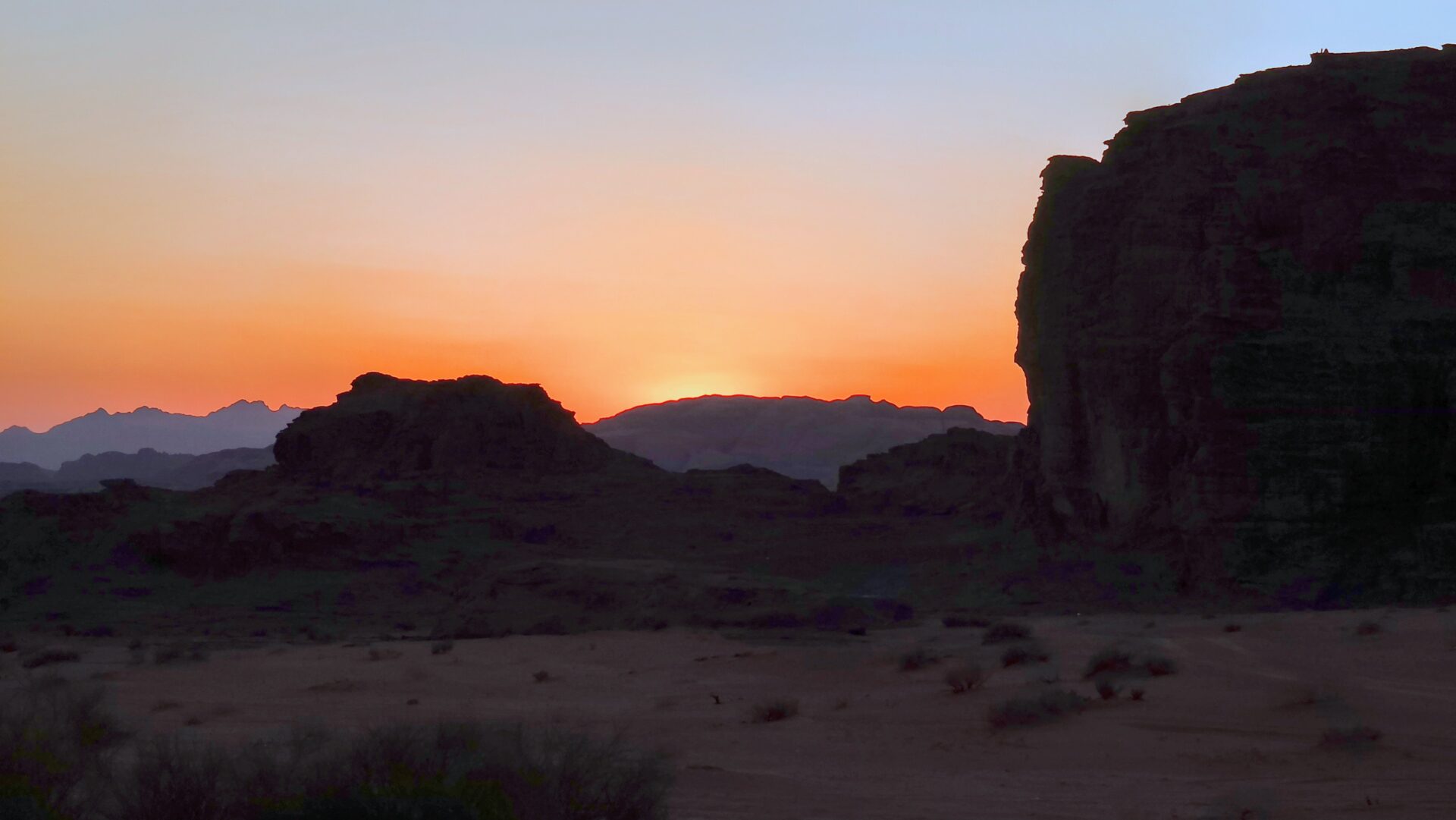
We made it to the desert. We had the place nearly to ourselves, because the war had emptied the country of tourists and gutted the local economy. Only one airline was flying into the country. Jan and I joked with one another that one way to avoid crowds was to travel in a war zone. It was restful, if not perfect. Then we came back, taught twice more, and boarded a plane for a few days of vacation in Spain.
I still picture the little screen on the airplane seat back in front of me when I turned it to the map and watched our plane cross the Jordan River. The cities appeared below, the places our pilot had carefully flown around on the way in. This time we flew straight over. I felt my shoulders climb toward my ears as the names slid past: Jericho, then Jerusalem, and finally Tel Aviv, until we were out over the open Mediterranean and I let out a breath I wasn’t even aware I was holding.
Spain was supposed to be the reward. The reward did not arrive on schedule. We landed in Madrid late in the afternoon, and the rental car took far longer than it should have. I ducked into a coffee shop to run a quick webinar. Then came the drive to a friend’s vacation home in Malaga, hours of it, into the dark. Kilometer after kilometer of black highway kept pulling my eyes shut in micro-sleeps, until I gave up, pulled into a gas station, and slept for fifteen minutes just to make the rest of the trip safely. We let ourselves in at two-thirty in the morning. The house was lovely. The road to it was not. Too little rest and too many unknowns had worn us both thin, and Jan and I had some hard days folded in with the good ones. We did not find our way back to each other until the last day there. We did find it, though. We came home steady.
A day or two after we landed, I had a call with my coach, Carla. I came to it with two big opportunities sitting in front of me. I had recently recorded an episode of a podcast that ranks among the top ten most-downloaded in any category, and it was set to go live within a few weeks. My website was set up to let people book twenty-five-minute clarity sessions, and a few dozen podcast listeners could fill my calendar overnight. I had also been invited to coach inside a group of hundreds of business clients.
I have spent years teaching people to meet opportunity with abundance instead of scarcity. On a good day, abundance is my native language. And yet there I sat on the call, asking the smallest version of every question. How do I protect my time? How do I keep from being buried? How do I not get overwhelmed? Not once did I ask where the opportunity was, or how I might reach more people with the very message I have built my work around, living and leading from overflow instead of overwhelm. Admitting that embarrasses me. I decided long ago, though, to lead with authenticity and vulnerability rather than protect the polished version, so I am telling you anyway.
As I talked, something I had not planned to say came out of my mouth. I told Carla about the relief. The relief from weights I had not known I was carrying until they lifted.
There had been the weight of living in a country at war. The weight of a basement apartment that held a bed, a kitchen table, four chairs, and an empty concrete room lit by old fluorescent tubes. Our hosts gave it to us freely so we could do the work we had come to do, and I was grateful. But it was still spare.
There had been the weight of not speaking the language. I joked later that I learned three things to say in Arabic: how to ask a man if he speaks English, how to ask a woman the same, and how to say that I do not know Arabic. In a grocery store, I asked the English-speaking clerk how to say sourdough in Arabic. He said, “Sourdough.” At a kebab counter I asked how to say kebab. He said, “Kebab.” We laughed. Underneath the laughing was a low, steady tax I had been paying for weeks, the plain fatigue of not being able to read a single sign.
While I carried it, none of it felt like weight, only the ordinary texture of the days.
You do not notice the pack on your back after two weeks of hiking in it. You notice when you finally take it off.
And then Carla asked me a question.
“What are you going to do to identify weights like this in the future, so you know they are there before they build up?”
I was too busy being relieved to remember the question. I just moved on as if she hadn’t asked. That is what unnamed weight does; it vanishes the moment it lifts, and takes the lesson with it.
I only know she asked it because I record my coaching calls with her. Days later, I fed the transcript into Claude and asked it to help me sort out my next actions, and it pointed to the question I had forgotten and ignored. In the moment, I sailed straight past her words and into my own relief, the way you step over a curb without seeing it.
A weight is anything you carry that presses on you: a responsibility, a worry, a decision, a person you are holding. The most dangerous weights are not the heaviest ones. A weight you can notice and name is a weight you can do something about. You can set it down, hand it off, or decide to carry it on purpose. A weight you cannot notice or name does something quieter and more insidious. It shapes how you answer your coach. It turns abundance into scarcity without asking permission. It has you guarding a calendar while a door swings wide open right in front of you.
I did come to know the answer to Carla’s question. Not on that call. A week later, in a way I did not see coming. That is the next part of this story.
For now, sit with one question, the same one I should have answered out loud and didn’t.
So ask yourself the question I skipped: What are you carrying that you would not know was in your pack until the day it was gone? What has grown so familiar that it just feels like the shape of your days?
I built a free worksheet for exactly this, called The Unweighting Practice. Five minutes, most mornings: name what you’re carrying, sort it, give it somewhere to go. Download it here.